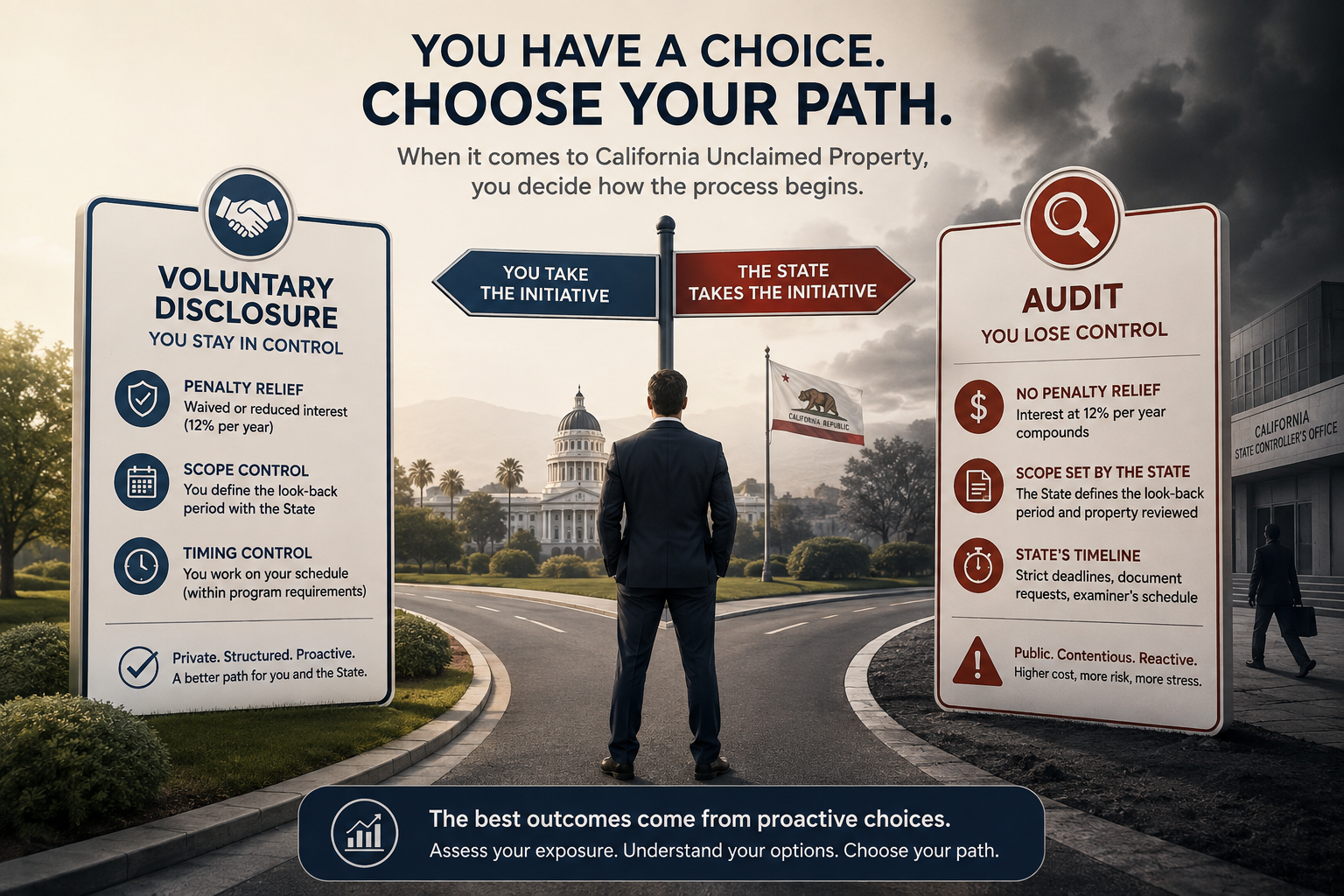
California’s State Controller’s Office has one of the most active unclaimed property examination programs in the country. In recent years, the state has expanded its use of third-party audit firms – contract examiners authorized to conduct examinations on California’s behalf, on contingency. That last word matters: the audit firm’s fee is a percentage of what they find. Their incentive is to find as much as possible.
Against that backdrop, the question facing any company with potential California unclaimed property exposure isn’t really “should we do something about this.” It’s “do we want to be the one who initiates this, or do we want to wait until California does?”
What the voluntary disclosure window actually gives you
California’s Voluntary Unclaimed Property Compliance Program provides three things an audit does not.
Penalty relief. California assesses interest at 12% per year on unreported property. On a five- or ten-year gap, that compounds into a significant number. The voluntary program waives or substantially reduces that interest. An audit does not.
Scope control. In a voluntary disclosure, you define the look-back period in coordination with the State Controller’s Office. In an audit, the state defines it. That’s a meaningful difference when you’re dealing with complex record histories, prior system conversions, or historical property types that are difficult to reconstruct.
Timing control. A company in a voluntary disclosure is working to its own schedule (within program requirements). A company under examination is working to the examiner’s schedule – with document production requests, response deadlines, and the rhythm of the audit itself shaping the process.
The window closes – and you may not know when
The voluntary program has one hard eligibility rule: it is not available once a company has been selected for examination. The moment California (or a third-party examiner acting on California’s behalf) notifies a company that it is under audit, the window closes. The company is now in an audit, not a voluntary disclosure.
What’s less obvious is that companies are sometimes selected for examination without realizing what that selection signals. An inquiry letter, a request for records, a call from a third-party audit firm – these can all be opening moves of a formal examination. By the time the company understands what’s happening, it may be too late to shift to voluntary disclosure.
The situations where voluntary disclosure makes the most sense
Not every company is a strong voluntary disclosure candidate. The program makes the most sense when:
You have known gaps. If your compliance team has flagged potential under-reporting – certain property types that weren’t captured, years where the process broke down, M&A integrations that weren’t fully reconciled – voluntary disclosure lets you address those gaps on your terms.
You’ve been through a system conversion. System migrations are one of the most common sources of unclaimed property gaps. Records fall through. Dormancy clocks reset incorrectly. A look-back before the state looks is far better than an examiner finding it first.
You have California exposure but haven’t filed consistently. Companies that have filed in some years but not others, or that have reported some property types but excluded others, are exactly who the voluntary program was designed for.
You’re in a regulated industry. Banking, insurance, and securities holders tend to face the highest scrutiny – and have the most to lose from a public examination finding. Voluntary disclosure resolves the exposure without the examination record.
What voluntary disclosure doesn’t mean
Entering the voluntary program isn’t an admission of wrongdoing. It doesn’t create any public record of non-compliance. It’s a structured process – similar to how tax authorities handle voluntary disclosure – that the state created specifically to give holders a path to compliance that’s better for both sides than a contentious examination.
It also doesn’t mean the work is light. A voluntary look-back requires real effort: pulling historical data, applying California’s dormancy rules to each property type, documenting the methodology. For companies with complex record systems, that work benefits significantly from outside expertise – someone who knows what California expects to see and where the common methodology errors occur.
The bottom line
The companies that get the best outcomes in California unclaimed property don’t wait for the state to act. They assess their exposure, understand the voluntary pathway, and make a deliberate choice about how to proceed. The companies that get the worst outcomes are the ones that were meaning to look at this eventually – and ran out of time.
Dunbar’s Reporting & Consulting practice has worked with holders across industries on California voluntary disclosure – from initial exposure assessment through final remittance. If you’d like a candid conversation about where your organization stands, we’re here to help.